Irish Wish: Movies about Writing

So it turns out this Netflix produced Hallmark movie rip-off starting Lindsay Lohan is about an editor who wants to get her own novel written/published . . . and makes a wish that she is marrying her last collaborator, Irish author Paul Kennedy. Waste of a wish, lady.

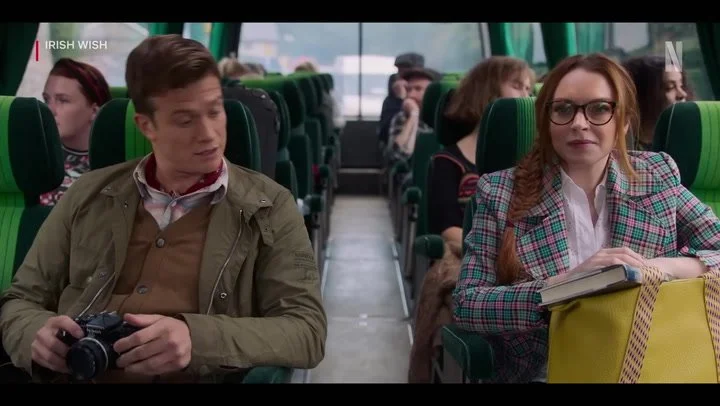
Maddie has worked alongside Paul (Alexander Vlahos) for a year polishing his latest bestseller and pining for him. However, he hits it off with her best friend, Emma (Elizabeth Tan). Next thing Maddie and her other best friend, Heather, (Ayesha Curry) know, they are in Ireland for the pairs wedding. Despite meeting a handsome English photographer named James (Ed Speleeers - you know, the kid from Eragon) upon arrival, Maddie still makes a wish that she was marrying Paul instead of Emma. A fairy (who is supposed to be Saint Brigid which is very confusing to me) dressed in late 60s mod fashion grants the wish. Now Maddie is marrying Paul and James is their wedding photographer. Oh and Jane Seymour plays her mom who spends most of the film on Maddie’s phone screen or in her own B-plotline. I expected more Jane Seymour.

Before I talk about the writing elements, I want to talk about the “Irish” elements. First of all, Paul lives in a giant estate with a English accent mom. Colonizers! You know his family stole land from the Irish long ago and clearly don’t care. Second, most people in the movie have no Irish accent or a really poor accent (sound like me when I’m trying to impersonate an Irish lady I stayed with on a college trip and who did not seem to care for me). There’s a scene in a bookstore where the clerk barely tries to use an accent, the puts a God’s eye in withe books purchased. Why? Third, the stock photo scene of the Irish countryside don’t match the sets where the actors are. Fourth, what the crap is a “wishing chair”? There are so many other ways they could have worked Maddie’s wish into the movie that come from actual Irish folklore. Even the movie Leap Year came from an actual old Irish tradition. Fifth, Maddie’s favorite author is James Joyce. No one’s favorite author is James Joyce. I think they just looked up the most famous classic Irish author and said, “That will work.” And lastly, Saint Brigid?! Sorry, I can’t get over that part.

Anyway, back to the parts about writing. Heather points out that Maddie had to edit so much of Paul’s book it was practically like she wrote it. I feel like if Paul was truly into his own writing, he wouldn’t have allowed her to change that much. Her character had been working as a freelance writer before that and I appreciate how the movie points out how difficult it is to live off freelance writing which is why she became an editor for the publishing company that handled Paul’s books. Also, Paul’s book is apparently in present tense which I can only handle in certain books. No wonder she had to over-edit it. Present tense is really hard to keep up throughout an entire novel. Paul writes both of their wedding vows, pointing out that HE is the writer, even though he knows she writes as well. Of course, they have to work the love story into her career. Paul states that he knows she needs time to work on her own novel, but first he wants her help on his next novel, despite him promising to hype her up to the publisher they both work for. Naturally, James points out that she should take time for her own writing and all that. James also notices the book she edited is better than any of Paul’s other books.

Spoiler Alert . . . After realizing that Emma and Paul are better for each other and that Maddie likes James, she reverses the wish. Oh, and she tells Paul to only work with her again if it was as a co-writer.
Young Cassidy: Movies about Writing

I’ve been meaning to watch this film for years. TCM plays each St. Patrick’s Day so let’s do this.

Young Cassidy is a fictionalized account of Irish playwright Sean O’Casey’s autobiography. Johnny Cassidy (Rod Taylor) lives in a rundown house full of books with his mother and siblings who are all desperate for work in English controlled Dublin. Cassidy’s writing begins with protest pamphlets about Irish nationalism. The anonymous pamphlets end up inciting riots where many people are injured and killed. Cassidy decides that stirring up violence isn’t helping and decides to write newspaper articles and dramas about the plight of the Irish instead.

When Johnny publishes his first article and is paid for it, he celebrates by buying six copies of the paper and a book on drilling. He and other men around town form a militia, however, when the men start to think illogically, Cassidy leaves. After a battle (a weird battle that has an Irish stereotype where a man’s whiskey is destroyed and while he moans about it is shot), he writes a book about his fallen friends and is paid 15 pounds by an English publisher in Dublin. Hover, they pay him a check when he has no bank account so he can’t cash the damn thing.

The first play Johnny sends in is sent back the comment “a bit long on character and a bit short on plot”. He edits it, sends it again this time famous playwright, poet, and folklorist W.B. Yeats sends it back, saying, “a bit long on plot and a bit short on character.” The third time he sends the play, it’s lost. This is a legit scenario here. Eventually, one of his plays is produced and he explains to his girlfriend that “writing is love” to him and she takes it personally. Still, she’s supportive when his first play is a flop. Despite the lack of commercial success, the founders of the theatre Yeats and Lady Gregory encourage him to write more.

I’ve never read anything by Sean O’Casey, but plenty by Yeats and other Irish writers of the time who tried to use Irish culture as a way subtly fight back against the oppression of the English. I know enough about the different reasoning for Irish protest to call it oppression. I though his sister’s story was the saddest. Ella married the first man she could to escape Dublin, but he abandoned her with five children. Their mother speaks of Ella’s depression and current personality, according to Cassidy, “as if she had died”. Spoiler alert - Ella does die. But it adds to Cassidy’s fight and trying to fight using as he says it, “Beauty”. “[Ella] used to say that beauty was more important than bread. How do I explain that to her children?”

This film was always advertised to be about young exploits and Irish shenanigans than writing. Among his political struggles are the tales of his love affairs. His first notable relationship is with scandalous actress and kept woman Daisy (Julie Christie). His second is with bookshop worker Nora (Maggie Smith) who is impressed with his love of reading and sends him books he tried to steal. Why is there no public library in Dublin at this time? It’s supposed by like 1910 or 1911. Most major cities in America had libraries? What the heck.

But the movie is more about his love of country and how he could use writing to rebel. Nora makes a classist comment about needing a “high education” to be a writer.

In Defense of The Changling (Copy)

It’s almost St. Patrick’s Day - Time for an Irish story!

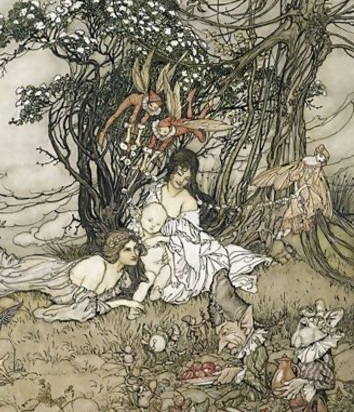
Brief History: Instead of focusing on a single story, I’ll just give a broad history of the Changeling legend. The general myth is that elves and fairies kidnap beautiful human babies and replace them with their own horrid children or with a piece of faeryland like a branch or log. Sometimes they also kidnapped grown women, creating beautiful mothers to care for the fae children. In order to bring back the kidnapped, you had to make the changeling laugh, treat it with love, or say the right prayer.

Analysis: The idea of having a child who did not seem “right” was a fear of all mothers in the time before psychological or scientific reasoning. The belief that such a child could be saved through simple magic must have been too great of a hope to let go of, which is probably why questioning the belief in changelings lasted until the 1800s in some countries and cultures.

Blame It on the Victorians: In 1895, Bridget Cleary was burned to death by her husband in front of a group of witnesses. Why did the townspeople of Ballyvadlea, Ireland stand by while this man allowed his sick wife to catch fire and burn? Well, because Bridget Cleary had been spirited away and this imposter had to die in order to bring her back? Due to this belief, Michael Cleary was only charged with manslaughter instead of homicide. In Ireland, this true event inspired more nursery rhymes and new fairy tales in which Bridget was a witch.

 Last Thoughts: A good way to make a changeling baby laugh is to boil and cook within an eggshell. Yeah… not really sure how that works, but best to try that before setting someone on fire.

changling.jpg

In Defense of The Changling

It’s almost St. Patrick’s Day - Time for an Irish story!

Brief History: Instead of focusing on a single story, I’ll just give a broad history of the Changeling legend. The general myth is that elves and fairies kidnap beautiful human babies and replace them with their own horrid children or with a piece of faeryland like a branch or log. Sometimes they also kidnapped grown women, creating beautiful mothers to care for the fae children. In order to bring back the kidnapped, you had to make the changeling laugh, treat it with love, or say the right prayer.

Analysis: The idea of having a child who did not seem “right” was a fear of all mothers in the time before psychological or scientific reasoning. The belief that such a child could be saved through simple magic must have been too great of a hope to let go of, which is probably why questioning the belief in changelings lasted until the 1800s in some countries and cultures.

Blame It on the Victorians: In 1895, Bridget Cleary was burned to death by her husband in front of a group of witnesses. Why did the townspeople of Ballyvadlea, Ireland stand by while this man allowed his sick wife to catch fire and burn? Well, because Bridget Cleary had been spirited away and this imposter had to die in order to bring her back? Due to this belief, Michael Cleary was only charged with manslaughter instead of homicide. In Ireland, this true event inspired more nursery rhymes and new fairy tales in which Bridget was a witch.

 Last Thoughts: A good way to make a changeling baby laugh is to boil and cook within an eggshell. Yeah… not really sure how that works, but best to try that before setting someone on fire.

changling.jpg