Ever Since Eve: Movies about Writing

I really like a Davies comedy. Marge (Marion Davies) plays the secretary of a novel writer named Freddy (Robert Montgomery) who thinks she’s a frump, when secretly she’s hot.

This story is more about sexism and abuse than it is about writing, but writing is a large part of Marge’s job. Marge has been repeatedly fired after ducking the advances of many bosses. In order to earn a steady income, she puts on an unflattering brunette wig, shapeless clothes, and thick glasses. She’s hired as a stenographer for a publishing agency full of male authors writing romance under women’s names. She’s assigned to Freddy Matthews, a best selling author who has difficulty focusing on his work.
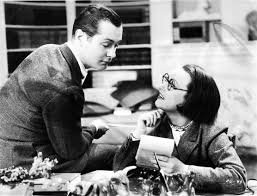
Marge, determined to keep her job, foils Freddy’s attempts to go on dates or take long lunches. She is especially good at keeping him away from his type-A girlfriend who monopolizes his time. Freddy realizes that Marge is good at her job when she temporarily quits when his girlfriend accuses her of having a thing for Freddy (which she does). I would also like to point out that Freddy has a classy, British butler who is Black. This is so rare in an old movie that I did a double take. Apparently, his name was Frederick Clarke and born in London. He didn’t get a lot of work in Hollywood. I could go on a tangent about this, but I better not.

Freddy goes to look for Marge, however he finds her in her normal clothes and blonde hair, thinking the pair are two different people. He takes out blonde Marge and I had flashbacks of watching Jem as a child. Seriously, she should have dumped her boyfriend. He was dating her, but in love with Jem and ddin’t know they were the same people! What were they teaching us 80s children?! In the case of this film, Marge and her roommate decide to tell Freddy that blonde her is out-of-town until the book is finished. She’s determined not to be herself again until the book is finished because Freddy will get sued by a film studio who already bought the rights to the book.

You probably know how all of this will end. Marge makes a good task manager and sounding board for Freddy’s writing. But I also feel like she should have steered clear of Freddy. He’s irresponsible and impractical. My guess is that he was well-off before his books starting selling, otherwise he’s be more worried about finishing his book.

Mank: Movies about Writing

David Fincher’s fictionalized tale of Herman Mankiewincz writing the script for Citizen Kane. This is not the first movie I’ve seen about this process (I sat through RKO 281 some time in high school and didn’t like how they depicted Marion Davies) nor am I the best person to tell you whether this movie is hard follow because I watch way too much TCM (that includes their documentary serious about movie moguls). What I can tell you is what it’s like to watch Mank as a writer.

The film focuses a lot on Mank’s (played by Gary Oldman) personality and alcoholism in the Hollywood world purchased by William Randolph Hearst (Charles Dance). By the way, this movie present Hearst’s long-time girlfriend Marion Davies in a way that showed her the way I like to imagine her - a little screwed up, a little suppressed, but overall a kind and fun-loving person. Amanda Seyfried nailed it in my opinion.

Image Property of Netflix

Image Property of Netflix

Okay, back to Mank himself. The struggling screenwriter, once a golden boy in Hollywood, has been given the opportunity to write the first draft of a magnum opus by rising start Orson Welles (Tom Burke). The catch is he won’t get credit and has been isolated in a desert cabin with sixty days to finish the epic film. Some people will say the Welles and Mank wrote it together, but I can’t help believing this version more (even though I know it’s not historically accurate). The idea is that because Mank has been blackballed by his own studio for his controversial drunken rants and not siding with the studio’s political views, no one will object to him being fully paid if he has no credit (make it look like he’s not working). On top of all this, Mank has recently been in a car accident, leaving him bedridden with a secretary (Lily Collins) to help him write.

Why, you may ask, has been sent into exile for this writing endeavor? For the deadline, naturally. Have you ever tried to get a writer who isn’t a journalist to meet a deadline? Do it. I dare you. Go up to a friend whose a writer, give them an idea, and say, “Could you give me a short chapter within the next seven days?” I almost always guarantee that it will become eight day at least. Artists - am I right?

Welles takes no chances and has deprived Mank of his family, his friends, proper alcohol (he has booze, but it’s drugged so he falls asleep after 1 bottle), and, thanks to the accident injuries, the ability to go outside easily. The movie delves into how Hollywood worked at that time, really focusing on how media can influence politics and how studios controlled their people. Mank is a sarcastic voice of reason and truth, making jokes to Irving Thalberg while criticizing him in the same breath. Hell. Hollywood still probably works like that (minus Thalberg). All of this honesty and drunken verbal vomit/literal vomit has left Mank without much work, his bosses being more concerned about punishing him than if he is still a good writer.

Welles credits himself for Mank writing one of the best things he’s ever written, not realizing that with the help of his secretary, Herman found ways to get back into his normal albeit destructive process. This is also important watching it as writer. Everyone has their own process and if you take that way, you can’t expect their best work. However, as I said, Mank was extremely self-destructive allowing both alcohol and guilty memories to destroy his brain. I don’t recommend his old school idea of a writing - men at typewriters with too much whiskey and not enough respect for the opinions of their intelligent wives. Which is my final thought. Fincher doesn’t glorify this behavior like some toxic-masculinity ridden Hemingway biography. He shows regret, pain, the effects on people around Mank, and how destructive is still destructive no matter what kind of art it produces.

Image Property of Netflix

Image Property of Netflix