
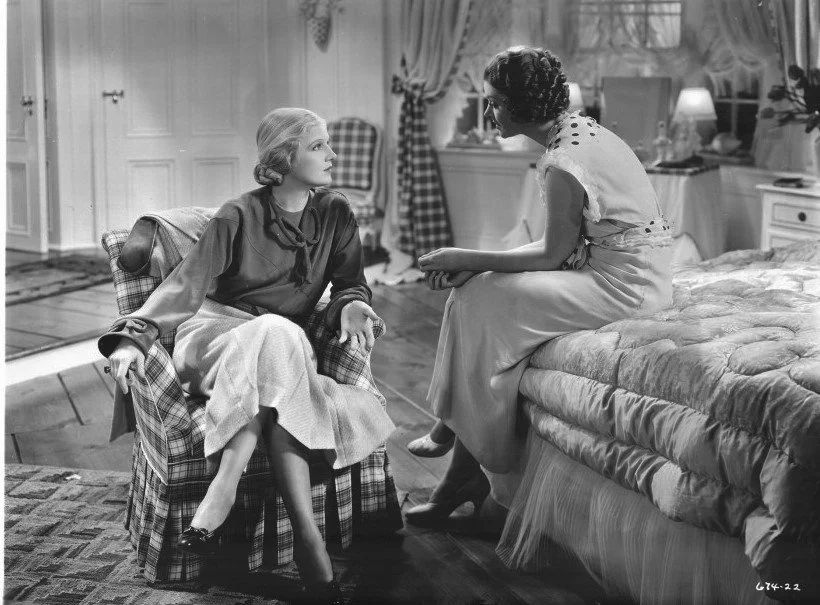
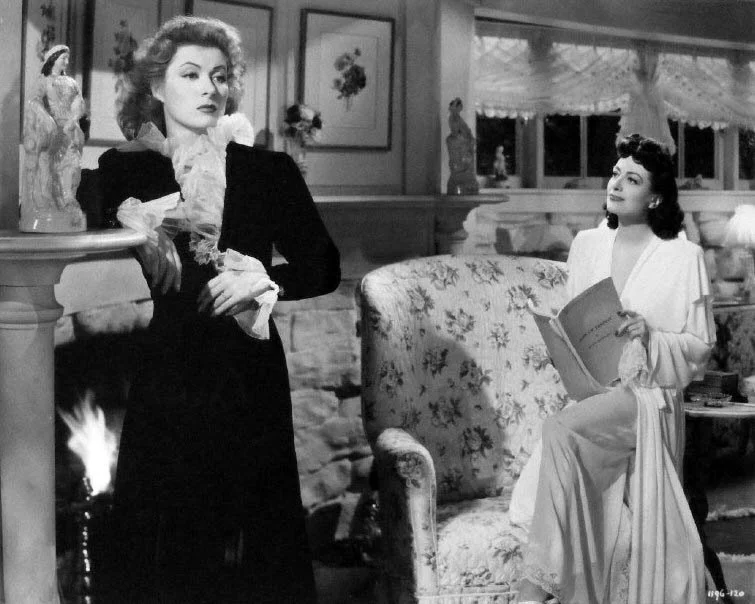
Yes, this another of those situations where the same movie was remade less than a decade after the original. When you can’t re-watch a movie on TV, it stands to reason that a studio can just remake it for more money. The two movies are very similar (the 1940s version is longer, but I’m going to focus on mainly what is the same in both - and the 30s version because I liked it better).
Mary (Myrna Loy/Joan Crawford) is a novelist working on the last chapter of her latest book alongside her publisher Woodruf (Frank Morgan/Herbert Marshall) who she not-so-secretly is hoping to marry . . . for some reason. Frank Morgan is not my idea of a zaddy, but to each their own I guess. In the 40s version, Mary is popular enough that people stop her at parties asking to have books signed. Jimmie (Robert Montgomery/Robert Taylor) is a journalist and friend of Mary’s who is in love with her, yet brutally honest. He points out how her previous book had more plot holes than “Swiss cheese” and if Woodruf praised it, he has ulterior motives. Jimmie tells her that she “used to be able to write about men and women” and that her “last book has neither”. He also points out that her writing a story about a married man who no longer loves his wife and finds another woman to end his suffering is a cheap cliche and that if Woodruf suggested it to Mary, she should be careful. Jimmie is blunt, but he seems like a good beta reader.
Another rather loud friend in their group almost admits that she usually doesn’t like Mary’s books, however shows interest in her love triangle story. It makes Mary think a little about how this new book might not be as good a Woodruf has been claiming. She wants the wife and mistress of her tale to meet and he objects as he knows this is her asking to do the same with his wife.
Jimmie sets up an impromptu meeting between Mary and Mrs. Clare Woodruf (Ann Harding/Greer Garson) without revealing to either woman who the other is. He’s not doing this to hurt Clare, who Jimmie instantly likes. He’s doing this try to knock sense into Mary (and convince her to finally him instead). Clare is a fantastic person, funny and intelligent. She wins Mary over with a wonderful review of one of Mary’s previous novels, stating how “true” the main character was. Mary loves this because it’s the first time a woman has made her feel good about her characters and writing style (usually, it’s just Jimmie). Rightly, Mary wants the opinion of women since her main characters are all women. Clare points out that “women can’t fool women”. Mary asks Clare to be a beta reader on her book about the mistress and wife, still not knowing who Clare actually is. Clare’s insight into the characters in Mary’s book by talking about her own marriage. Mary is shocked that any many would cheat on Clare.
I won’t give away the ending, but I will say I liked it. It does include women with empathy, acts of self-confidence, and a writer who realizes that she doesn’t understand people as well as she believed.
Best lines:
Mary: “I’ve been working on the last chapter today.”
Bridget (Mary and Jimmie’s friend): “Oh, have you, Mary? Well, well, I didn’t know that. I mean, I saw you sitting around with the pencil in your hand, but I didn’t know anything was going on. Anything creative, I mean. This creative business is so funny. You never do know what is going on. I suppose people themselves, don’t.”

Quisque iaculis facilisis lacinia. Mauris euismod pellentesque tellus sit amet mollis.