
Somewhere in Time: Movies about Writing

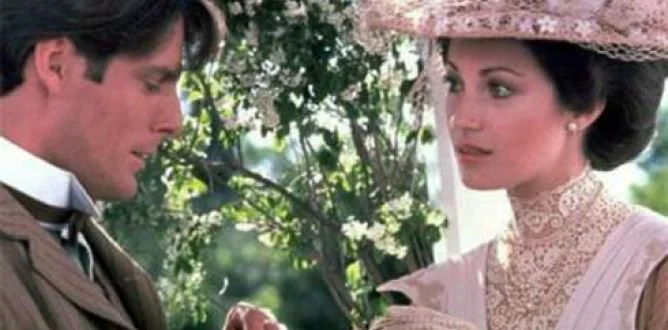
My mom loves this movie, especially the soundtrack. Richard Matheson wrote the book this is based upon where the main character is also named Richard. This Richard is a playwright portrayed by Christopher Reeve who falls in love withe a 1912 photograph of actress Elise McKenna (Jane Seymour) while staying in a historic seaside hotel. Through this obsession, Richard manages to time travel and meet Elise, causing her to fall for him as well. Matheson based the idea on his youthful obsession with a photograph of Maude Adams, who he researched and based Elise upon (although I’m fairly certain that the real Maude Adams was gay).

The movie opens with Richard as a college student who is presented with a pocket watch from a mysterious elderly lady who pleads with him to “come back to her” at his first successful play. Years later, while going through a writing block on his latest work, Richard goes to a hotel as a way to jump start his brain and sees the photograph, discovering that Elise was who gave him the watch almost a decade earlier. He gets personal information from Elise’s biographer Ms. Roberts (Teresa Wright), discovering that after a final performance in 1912, Elise completely shut herself off from the rest of the world.

Richard manages to hypnotize himself back in time to meet Elise and her obsessive (this story has a lot of obsessive men) manager William Fawcett Robinson (Christopher Plummer). The somewhat psychic Robinson believes that Elise has a destiny on the stage and objects to the budding romance between the pair. Jane Seymour does a fantastic job as a comedic actress of the time and Plummer is creep in his high back chair sitting in the wings. I do like a scene where Richard watches the 1912 cast being criticized by their playwright, showing that nothing ever changes.

SPOILER ALERT: The couple are very happy for a time, making plans to marry and run away from Robinson. The manager tries to separate them and make Elise think Richard doesn’t love her. However, she is steadfast and leaves Robinson to find Richard. Just as their lives look to be content full of future plans, Richard comes across a 1970s coin in his pocket which breaks the hypnotism and sends him back to his own time.

Long story short - Richard never finishes his play. He throw away a successful career to SPOILER ALERT (again) slowly dies of a broken heart. Don’t get me wrong, this is a great movies but . . . In my opinion, I get that they are supposed to be a great love story, but he sort of ruined both of their lives. She spent the rest of her life pining for him and he died young pining for her. I supposed they meet again in the What Dreams May Come afterlife.
Twilight Zone (A World of His Own): Movies about Writing

Oh “Twilight Zone”! How do I love thee! Let me write a blog of one of my favorite episodes instead of counting the ways (because math is bad). Let me present “A World of His Own” about Mr. Gregory West, a playwright who gets very into his work and uses a dictation machine for recording his character development. In order to talk about how this episode relates to the personality of writers I am going to have to give BIG SPOILERS.

NO SERIOUSLY - SPOILERS AHEAD! I WARNED YOU!

Rod Serling fading away from reality (CBS owned image)

Rod Serling fading away from reality (CBS owned image)

First off, this is a Richard Matheson episode so that might be partially why it is one of my favorites. It also features an adorable Asian elephant, but that’s not really important to this blog. Gregory West (Keenan Wynn) is having a comfortable and loving time with the sweet Mary (Mary . Then his wife, the stylish Victoria (Phyllis Kirk) see him and Mary cuddling on the couch only to storm into an office where only her husband exists. No Mary and no exit she could have sneaked out of.

What continues is a conversation about how writers dream up characters that are real to them; a conversation that turns out not to be practical not philosophical. “They [characters] become so strong, that sometimes they take over the whole story,” Gregory explains to his wife and adds that one of his earliest successful characters walked into the room one night when he was working. It turns out that when he describes a new person into his tape recorder, the fictional character comes to life in his office and gives him inspiration for his plays. Then, all he has to do to send them back into his imagination is cut the tape and burn it.

This is the origin story of Mary (and others in the episode as well), but he has difficultly getting his wife to believe this as she plans his commitment. And in the case of Mary, he has created a woman who fulfills his sentimental needs that his high fashioned wife neglects. Still, she has a mind of her own and questions her role in Gregory’s life as he keeps creating and destroying her.

Overall, this episode all about the imagination of a writer and how tempting imagination is over reality. More than that, it is an idea of using the power of imagination responsibly. Where Gregory could rewrite his life with every character he could ever want, he only uses it as a way to keep from being lonely. And yet, instead of finding a woman in the world he creates his partner to fit ideals he has learned through out his life. Most writers start this way. They start as children daydreaming about different lives surrounded by different people. And yet Matheson presents this idea in the form of a full grown man and established playwright. This adds a little humor to the scenario. It begs the questions of how many of us would spend time with our characters as flesh and blood instead of just the voices in our heads.

TWILIGHT_ZONE_SEASON_1_DISC_5-4.jpg