Cinderella II Dreams Come True

There was a dark time in Disney’s history. Not as dark as right now with all of the live-action remakes. These films at least tried to tell a new story, yet still - a bleak history. This was the time of the direct-to-dvd Disney films. And there were so many of them. So. Many.

This one is particularly sweet and dull. It came out when I was a senior in high school and I would have been protected from it if I didn’t have a baby niece. My mom bought every one of these so we could keep the small child amused and, much to my regret, said child really liked this one.

Told in an anthology style, the mice regal the audience with three tales of Cinderella’s married life. They are creating a book with the help of the Fairy Godmother, who apparently just chills in the castle without any of the humans knowing.

The first story is about Cinderella being required to plan a royal banquet with the help of a strict housekeeper named Prudence and a pair of ladies-in-waiting who are not afforded the luxuries of personalities. Cinderella is dressed in restricting clothes and given a long list of rules to follow. The part of this story I liked was that they established that Cinderella had friends in the village. It makes sense that she would be popular among shop keepers and commoners. What I hated was Cinderella expressing a valley-girl-esque “ew!” when she finally removed the historically incorrect gown. This is of course when she decided to be herself and do things her own way. A very nice message, however I would have preferred it without a pop song.

The second story is the one that for some reason bored me the most as a teenager. Jaq the mouse is depressed that it’s to difficult to help Cinderella in a giant castle. He makes a wish to be human and the Fairy Godmother turns him into an Ichabod Crane knock-off. This misadventure then depresses Gus-Gus and Jaq’s neglected girlfriend Mary (a random female mouse who sounds like the Chipettes). Then, another pop song played, thus depressing me. This story is also about being yourself. Jaq does get some revenge on a castle’s cat who is a pale comparison to Lucifer in the first movie. Why are cats in Disney movies all motivated by bitchiness?

The third story is the only one really worth watching. Cinderella’s stepsister, Anastasia (the red-headed one , in case you weren’t sure) gets a crush on a baker in the village. Cinderella sees this “while in disguise” which really just means she’s in her scullery maid dress. How is that a disguise? It was already established that she has friends in the village so won’t they recognize her in her old clothes? Let’s have some continuity, people! Anyway, Anastasia’s mother and sister make fun of her while Cinderella offers to help. This is where you get the only line in the movie I really appreciate. Cinderella tells Anastasia to be kind because, “You catch more flies with honey”. Anastasia promptly asks, “Who’d want to catch flies?” She has a point.

Off topic, but does anyone else find it really weird that Anastasia owns a music box with dancing figures that look like Cinderella and the prince inside. I mean, why is the kingdom selling royal merchandise? And did Anastasia have to buy it full price or was it a friends and family discount kind of thing?
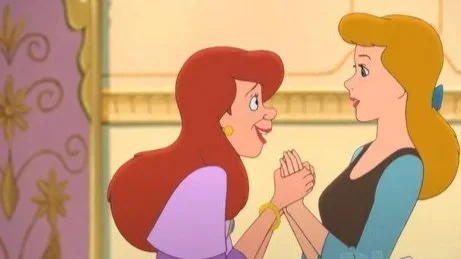
Back to the story. Anastasia suffers a Hallmark Channel movie misunderstanding where she thinks the baker already has a girlfriend. The baker suffers his own mishaps in attempting to court Anastasia. Then, Anastasia stands up for their awkward relationship to her mother and, get this, learns to be herself. There was a theme!

Was this worth watching again for the sake of a blog. Not really.

Mystery of Historical Monsters

For those of you that know me well, you know I possess an unhealthy amount of knowledge of fairy tales in general. This fairy tale trivia led me to have an equally unhealthy knowledge of Marshal of France Gilles de Rais.

If you have pushed the 1999 Joan of Arc movie from you mind, allow me to refresh your memory. Jeanne, the French farm girl who led armies against the English during the Hundred Years War and got a warm stake for her troubles, had a commander who served with her. When the war ended, de Rais went home where he squandered his fortune on a play he wrote, defied the church by building a chapel that did not fully conform to the 1430s religious norms, and started to practice occult rituals. Oh! And he was tried then executed for the brutal abuse and murder of approximately 150 young boys. Did I almost forget to mention that part?

Gilles de Rais became the bogeyman of the French medieval world. He was hanged and burned for what is the most evil of human atrocities, and thus became the cautious tale parents told their children. Over the next two centuries, the story of a child killing lord morphed into that of a wife killing lord called Bluebeard who kept the bodies of his victims on his property as de Rais supposedly did. That's right! That’s the plot of a fairy tale, for those of you who didn’t know. But you will probably hear me talk more about Bluebeard later.

The mystery I present today is not about the fairy tale or the crimes themselves – it is about how society wants to hold onto the morbid belief in such heinous monsters. Over the last several centuries, it has been suggested that de Rais was framed for his crimes, that he himself was the victim. The same has been suggested of Countess Bathory, the woman walled up in her own castle for the torture and murder of young women because of a belief that bathing in their blood would keep her young. Several historians have wondered if the crimes against Bathory were really a way to knock a woman from her position of power. Remember, the Middle Ages were not huge fans of women in general. Unless you count that woman who was the first to create a foaming, full headed beer. I bet they loved her.

The idea of de Rais’s innocence is that he was targeted by the church and those who wanted his wealth or remaining lands. It didn’t help that Joan herself was burned for heresy or that two of the judges at his trial were men who could legally inherit his property. Every few years, another article or book comes out wondering if de Rais was a legit serial killer or another target in a church “witch hunt”. And every few years, people familiar with the story scoff.

I am not saying which way I side with. I am just wondering why people hold on so tightly to the monsters. Some just want to believe that de Rais and Bathory did these terrible things and don’t want to hear the other side. They want Bluebeard to still be Bluebeard. And why? Why is there insistence that the Hills Have Eyes really is based on a true story and not English anti-Scottish propaganda?  Why are there some who seem disappointed when told the truth of Ed Gein, when what was wanted was a mix of Texas Chainsaw Massacre and Silence of the Lambs? Are we that morbid that we need the monsters to be the most monstrous they can be? Is it just the need for bogeymen and a good scare? Or maybe you just said to yourself, “Gross. I do not feel that way.” Fair enough, but I bet you know someone who does. Even the content of most crime dramas and Lifetime movies would suggest a need for morbid curiosity.

It could just be that everyone needs a good scare once in a while and all of these historical figures are more the stuff of legend than reality. It feels safe to villainize those who were tried and found guilty and safer still when they died hundreds of years ago. Or I could just be way off base here and sufficiently creeped some of you out.

I would tell you to go watch a Disney movie to make yourself feel better. But don’t get me started on the morbid background of those!