Come Live with Me: Movies about Writing

Let’s look at some scandalous behavior - 1941 style.

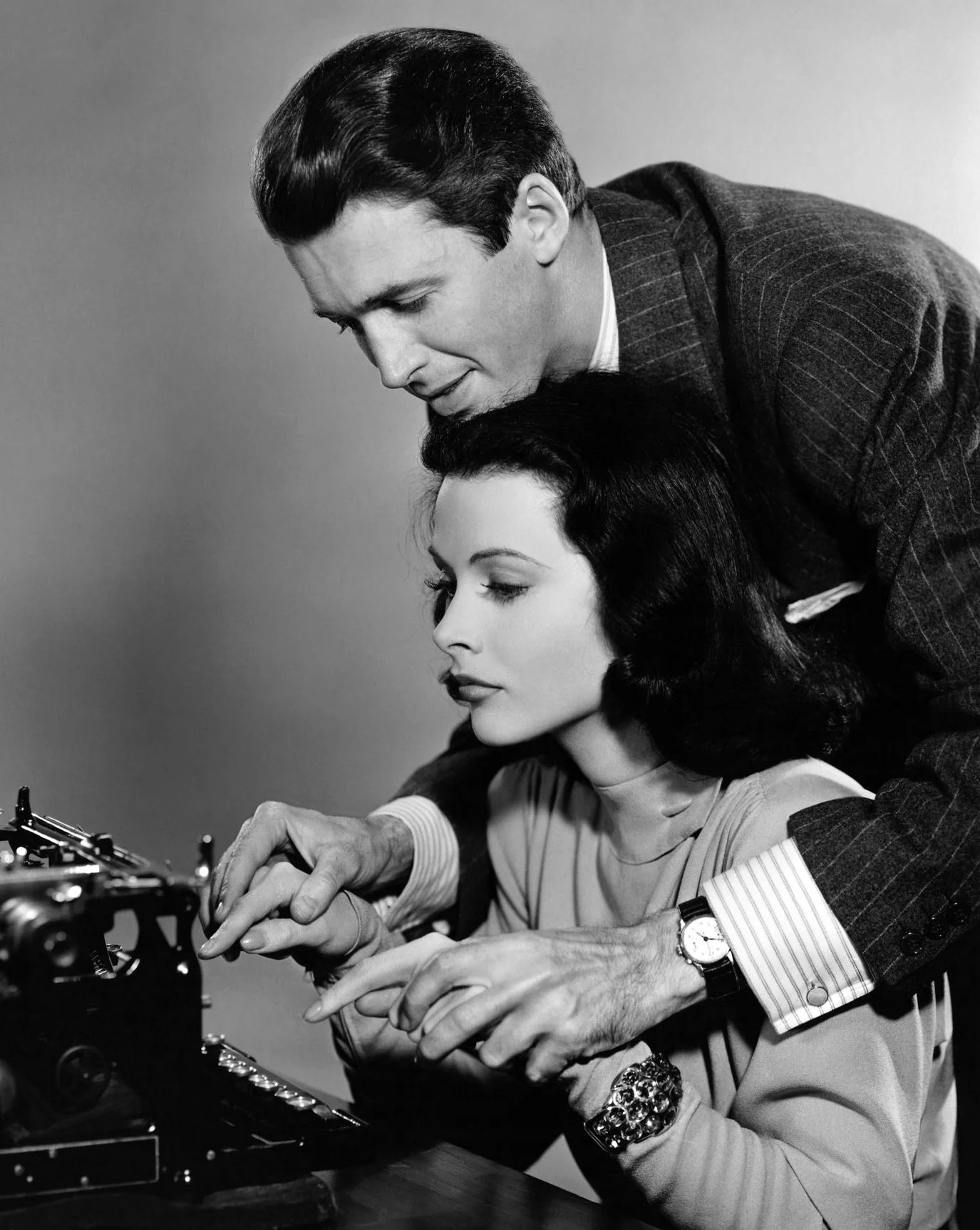
Johnny Jones (Heddy Lamarr) is an immigrant escaping Nazi occupied Austria. Barton Kendrick (Ian Hunter), her publisher boyfriend, is desperate to keep her in America, however he’s already married (gasp). By the way, how did this woman escape from Vienna DURING World War II. The real Heddy Lamarr got out before the war broke out. Johnny meets a broke writer, Bill Smith (Jimmy Stewart) and pays him to marry her so she can stay in the country. The exact amount is the bare minimum of his living and typewriter expenses and Bill plans on paying her back when the whole thing is over.

The arrangement is that once a week they meet up for her to pay him and he knows nothing else about her. Bill is instantly intrigued by their situation and starts typing it into a novel. Bill sends a carbon copy to every publisher in the city in a scene of him with pushing large packages into a mailbox. It looked exhausting.

Bart learns about this situation when his wife, Diana (Verree Teasdale - how’s that for a name) reviews Bill’s book for the publishing company. She gives him the summary, explaining how implausible it is and still needs an ending. Still, she’s confident that Bill’s writing is so strong that the book will sell.

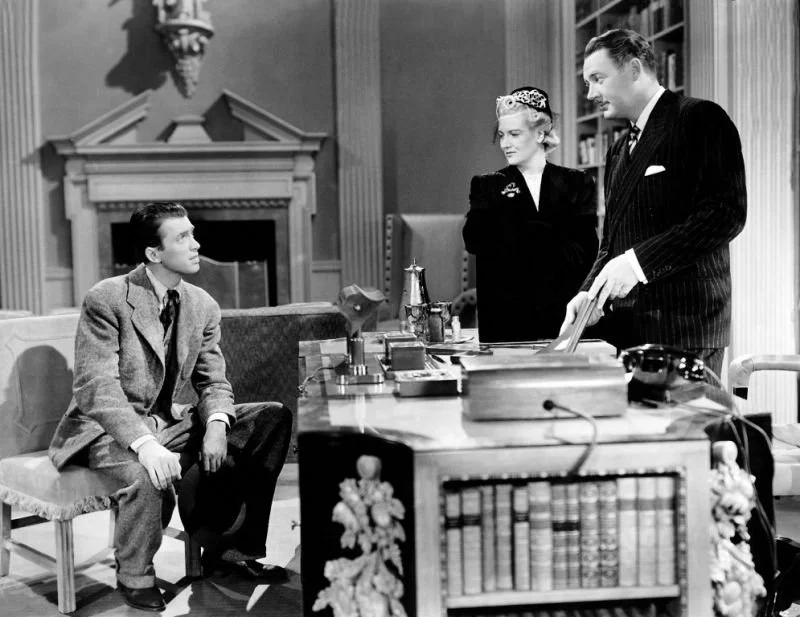
Bart recognized the scenario and calls in Bill asking him where he got the idea of the story and why the character of the “other man” (who is Bart in reality) is not as well written. Bill states that the character is giving him a lot of trouble and hopes to write him out by the end of the novel. Bart debates the ending with Bill in front of Diana and gives away his affair. Diana also forces Bart to give Bill an $500 advance on his book. $500! Holy crap! Diana, I know you are realizing that you want Bill to get the girl so your husband doesn’t, but I still salute you.

Bart’s wife is really a key in his publishing business as she has more insight into public trends and what would ruin him. That having been said, he still cheats on her and is under the delusion that he’s successful on his own. Bill on the other hand has gifted kid syndrome. He’d been told he was a genius and feels like he has nothing to show for it. When he's working out the novel, he outlines each chapter with the questions he’d like to ask Johnny about her life. Realistically, Bill is working in his pajamas. I am currently doing the same. Respect, Bill. Respect.

My favorite scene is when the milkman asks Bill how the book is going. He told his wife the plot and she’s excited to read it, stating it will only be really good if the couple end up together. Bill admits that his characters aren’t together.

“What’s keepin em?” the milkman demands.

“The girl.” Bill states this after writing all night.

“Well, you’re never going to get no place if you let her act like that!”

SPOILERS

Bill refuses to to divorce Johnny unless she comes on a trip with him. He uses the $500 advancement to take her to meet his grandmother and see where he grew up. She calls Bart to complain about being coerced into the trip so he can come rescue her. Of course, by the time Bart shows up, Johnny is having a good time and falling for her husband. Bill tells her that writing about her is why he’s successful now because he needed to write about his real feelings. Naturally, Bart shows up just as Johnny decides she wants to stay married to Bill. There a brief moment where Bill worries that his new writing success is not based on his own merit, but Bart admits that Diane said it was good and he always trusts her. It’s a good thing he goes back to his wife at the end or he wouldn’t have a publishing house any longer.

No Time for Comedy: Movies about Writing

What can I say? I like Rosalind Russell movies. Plus in this one, James Stewart plays a guy named Gaylord Esterbrook. Heh heh heh. No one is laughing? Fine. Here’s the movie. Spoilers ahead.

Gaylord has taken a break from small town reporting to write a comedy about life in New York City (a place he’s never been to until a group of producers bring him and his play there). While working on rewrites, Gaylord is mistaken for an usher by the leading lady Linda (Russell). In fact, no one believes he’s a writer at first based on his usual Jimmy Stewart looks. However, he has a refreshing view of tourism. For example, he wants to travel by subway during rush hour so he can “have the experience”.

Despite the rough writing of his third act, Linda convinces the cast and crew to give the play a chance. When it’s a hit, Linda and Gaylord marry. He continues to write comedies all starring her, which their director friend Morgan says have the same story every time. Linda declares how strange it is to pace the corridor “waiting for your husband to give birth to a play”. However, he falls into the stereotypical pattern of New York writers when he hits a block - drinks and takes trips out of New York.

At a party, the couple meets Amanda and Philo Swift. Philo asks what Gay does for a living and he says playwright, Philo responds, “Yes. Er, yes, I have a hobby, too. What I meant was, what do you do for a living?” The financier finds the job of “writer” rather juvenile, however his wife finds it fascinating. Gay declares that he doesn’t want to write anything else unless it has an important message, an idea given to him by bubble-headed Amamda. Linda states that if Gay and Amanda affair, Amanda should at least leave his writing style alone.

Gay writes a play about immortality, fascism, and general human drama which 1) has no part for Linda, 2) causes their friend/maid to hold it out in front of her between her thumb and forefinger, and 3) is unintentionally funny because it’s so badly written. Not wanting to hear Linda’s criticism or jokes, Gay leaves her for Amanda and Philo agrees to marry Linda since they become friends.

Amanda shows how she truly does not understand how a creative mind works when she can’t understand Gay’s opening night jitters. And the play is awful. No one has a single positive word to say between each act. Morgan says how he’d never feel bad for a playwright, but he can’t help pitying Gay. We as the audience should pity Morgan as Amanda tries to get her hooks into him at the end of the night. After it all, Linda tells him that 4 hits and 1 flop is not a bad record. They talk about how to turn the drama into satire about the rise of dictators. And he realizes that even if she’s not his muse, she’s better for him and his writing because she’s a constructive critic.