

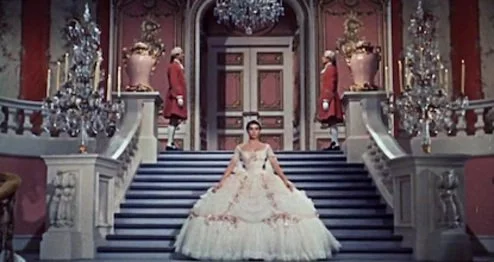
One of my favorite Cinderella movies was The Glass Slipper from 1955 staring Leslie, Caron, Michael Wilding, Keenan Wynn, Estelle Winwood, and Else Lanchester (with Walter Pigeon as the Narrator).
In this version, Ella is the way we would perceive a traumatized young woman who had grown up, as they say in the movie, “rejected”. She does not accept her lot in life with a sigh and a smile. Instead, she is constantly triggered by the feeling of being bullied and made-fun-of. She reacts with childish acts of destruction. She even pushes the prince into a pond at one point when he was staring at her. This version even touches (not very well) on the concepts of depression and thoughts of suicide. When asked about her short hair (which was Leslie Caron’s signature look), Ella states that she was angry enough to wish she was dead, but cut off her hair instead. This really should have been something other people should react to, but since this movie is made in the 1950s, other characters do not pry.
But she is also someone who dreams and responds to love the way a mentally abused person might. She boasts that a fortune teller told her mother that she would live in the palace of the duke one day and has imaginings of rather sparse royal room where she is a bored noble. While everyone else teases her, Prince Charles says “It’s nice to have something to hope for”. While her stepmother and beautiful, but cold stepsisters continue to keep her in a strange limbo between family member and servant, she befriends the eccentric Mrs. Toquet. The first person Ella says I love you in the movie to is Mrs. Toquet which is so much nicer than the story just being about her love for a prince that will “save her”. Ella was a person not expecting to love anyone in her life and Mrs. Toquet tells her that if you learn to love one person you can learn to love others. What Ella really needs is therapy, but having people who care about her actually listen is the closest you can get in the 18th century.
Mrs. Toquet is a fantastic “fairy godmother”. She was a former wealthy widow who lived on the grand hill, but “took to reading books and went from bad to worse”. She loves words that are fun to say (a trait I picked up as child because I realized she was right - some words are just fun to say! Say “Quetzalcoatl!") and likes to borrow items from the townspeople. She collects odds and ends for unknown purposes then returns them promptly. Although she is never shown doing magic, it is hinted then stated that she is indeed a fairy in disguise. Still, she adds a much needed liberated women’s element to the story, someone who encourages Ella that she doesn’t need to change who she is as a person, just learn to accept good things when they happen. This screenplay was written by Helen Deutch who also adapted National Velvet and The Unsinkable Molly Brown which leads me to think she was probably more feminist than her time period would give her credit for.
When Ella has to practice walking in the titular glass slippers and comments on how strange they feel, Mrs. Toquet says that all woman must endure fashion discomforts because it fascinates men because they secretly know they couldn’t handle it. I have some issues with this explanation, but it still makes for a nice semi-pro-women joke in the 1950s (take what we can get I guess).
In this, Prince Charles is the son of the Duke who has just come home with his best friend Kovin and is expected to settle down. However, he is automatically smitten with Ella, an attraction Kovin warns him against because Charles has weakness for women he wants to save. This is just a strange character element to throw in. It makes the prince so much more than someone who falls in love with beauty, but he’s still flawed. He does get to know Ella and falls in love with her (not just her sad eyes and clear need for a therapist), but tell her he’s the son of the cook in the palace of the dook (uh - duke).
The only part of these that doesn’t always appeal to all fairy tale or even old film aficionados are the lengthy ballet fantasy sequences to show off Leslie Caron’s dancing skills. Look, I love ballet, but even I get up and get a snack during these parts. The one where she imagines being the wife of a cook is especially lengthy and I don’t think I’ve sat through in entirely since I was seven.
One last thought is how the Ella character gets to “grow up” in this one. She goes from throwing tantrums to attempting to stay calm and polite to people who care about her.


Quisque iaculis facilisis lacinia. Mauris euismod pellentesque tellus sit amet mollis.